This guide provides a complete, transparent breakdown of what it actually costs to hire an accountant in 2026 across different hiring methods – traditional in-house, staffing agency, and a talent marketplace like MAVI – so finance leaders can make fully informed decisions.
Written by
MAVI
Published On
March 10, 2026
Most companies underestimate the true cost of hiring an accountant by 40–60%. They budget for salary and benefits, then discover that recruiter fees, onboarding time, productivity ramp, and the cost of a slow hire add thousands to the total.
This guide provides a complete, transparent breakdown of what it actually costs to hire an accountant in 2026 across different hiring methods – traditional in-house, staffing agency, and a talent marketplace like MAVI – so finance leaders can make fully informed decisions.
Rising costs in the Accounting Talent Market in 2026
Several structural forces are driving up the cost of accounting talent this year:
The Nationwide Accountant Shortage
The number of students sitting for the CPA exam has declined for consecutive years. Fewer new entrants, combined with an aging workforce exiting the profession, means supply of experienced accounting professionals is contracting while demand from growing businesses increases.
Salary Inflation for Experienced Mid-Level Talent
Accountants with 5–7 years of experience, skilled enough to manage complex processes independently but still hands-on, command premium salaries in a tight market. Senior Accountants in major US markets now routinely earn $90,000–$130,000+ annually.
The Hidden Cost of Long Hiring Timelines
The average accounting role now takes 2–6 months to fill through traditional channels. Each month an accounting seat is vacant costs the company in delayed closes, overworked staff, and deferred reporting – costs that rarely appear in the hiring budget but are very real.
Rising Recruiter Fees in a Competitive Market
As accounting talent becomes scarcer, recruiting fees have crept upward. A 20–25% placement fee on a $110,000 salary is $22,000–$27,500, paid before the hire starts work.
Full Cost Breakdown: In-House Hire
This is what a single mid-level Senior Accountant hire actually costs when all components are included.
Direct Compensation
One-Time Hiring Costs
Productivity Loss During Vacancy and Ramp
Total First-Year Cost of a Traditional In-House Hire: $159,100–$280,000+
This is the number most companies aren't budgeting against. The base salary line is only 45–55% of the true first-year cost.
Full Cost Breakdown: Staffing Agency
Robert Half's model introduces a different cost structure – but it isn't cheaper. In many cases, it's the most expensive option.
According to MAVI's market research, the effective cost of temp staffing is more than 70% higher than MAVI's equivalent placement when comparing total cost. Staffing agencies are not a cost-saving solution; they’re a convenient solution with a significant price premium attached.
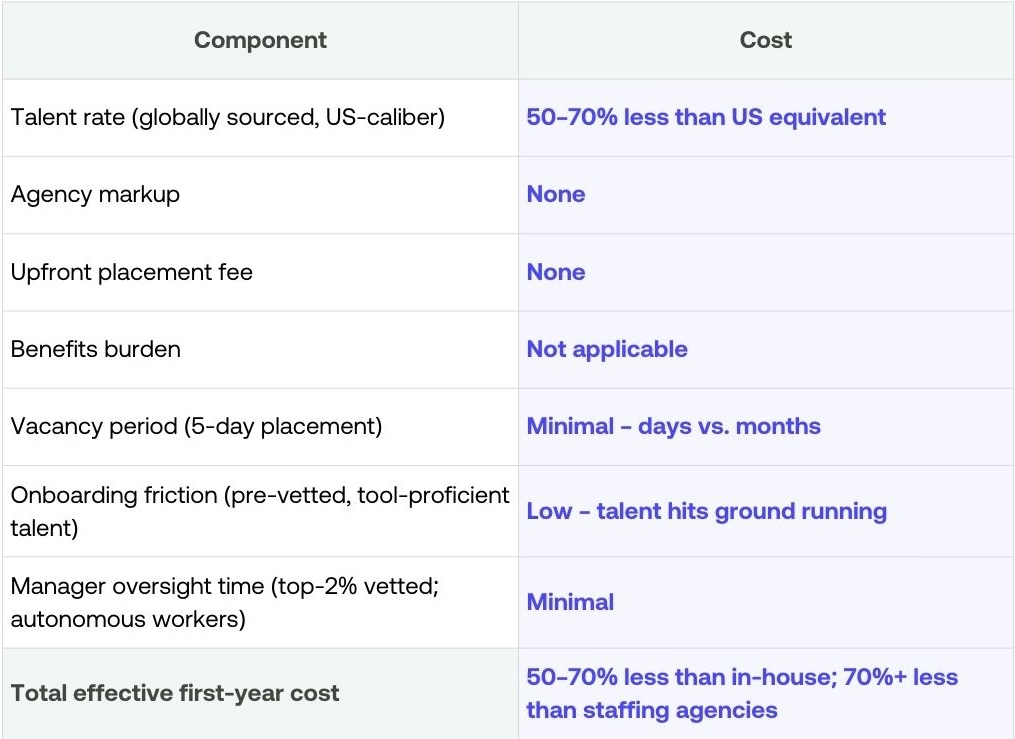
Full Cost Breakdown: MAVI
MAVI's model is structurally different from both in-house hiring and traditional staffing agencies.
The compounding effect is significant: MAVI eliminates the placement fee and benefits burden, compresses the vacancy period from months to days, and delivers talent that requires minimal ramp time due to rigorous pre-vetting.
Side-by-Side Comparison: True Cost of Hiring a Senior Accountant
The Hidden Costs Most Finance Leaders Overlook
Beyond the direct numbers above, there are three hidden costs that finance leaders consistently underestimate:
The Cost Of A Bad Hire
If a hire doesn't work out in six months, you've paid six months of salary and benefits, lost months of productivity, and now face the entire search cost again. Studies estimate the cost of a bad mid-level hire at 1–2x annual salary. For a $100,000 accountant, that's $100,000–$200,000. MAVI's rigorous vetting dramatically reduces this risk.
The Cost Of Management Overhead For Underperforming Talent
A common complaint with staffing agencies – and with poor hires generally – is that the finance leader ends up spending significant time overseeing and correcting work that should be autonomous. At a CFO's fully-loaded hourly rate of $100–$200+, 10 hours a week of unnecessary oversight is $52,000–$104,000 per year in lost executive productivity.
The Cost Of Delayed Financial Reporting
When an accounting role sits unfilled or is filled by underperforming talent, financial reporting slows down. For PE-backed or VC-backed companies with investor reporting requirements, this has real consequences – from strained LP relationships to delayed decision-making that costs the business operationally.
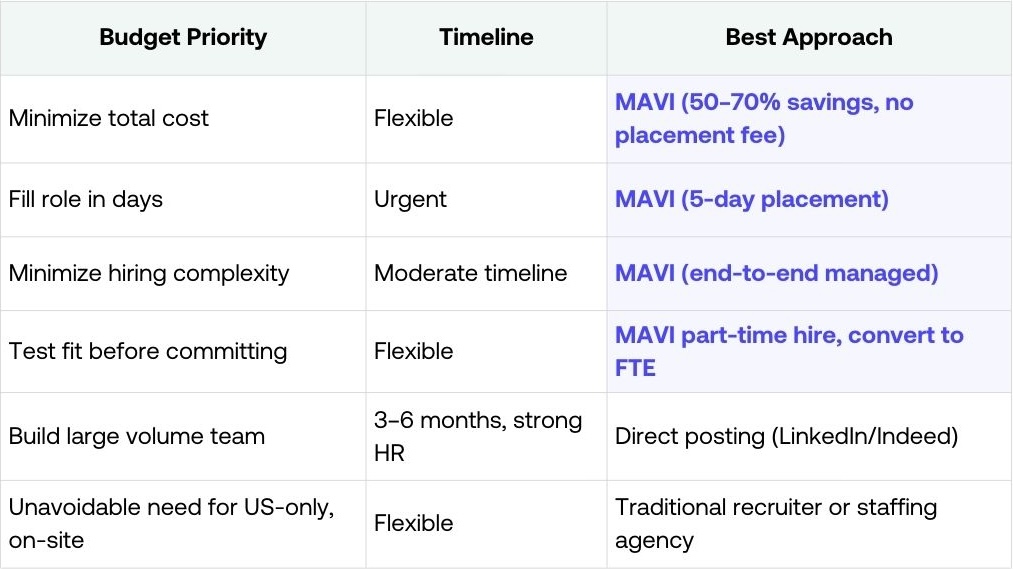
Matching the Hiring Method to Your Budget and Timeline
How to Reduce Your Accounting Hiring Costs Starting Now
Step 1: Audit what you're currently spending
Use the full cost breakdown above to calculate your real cost-per-hire, including vacancy period and onboarding. Most finance leaders are surprised by the number.
Step 2: Evaluate whether full-time is actually necessary
For many growing companies, a fractional or part-time accounting engagement delivers 80–100% of the value at 40–50% of the cost. MAVI's fractional model is designed for exactly this.
Step 3: Eliminate the recruiter fee
A $20,000–$30,000 recruiter fee is avoidable. MAVI delivers better-vetted candidates faster, with no upfront fee.
Step 4: Compress the vacancy period
Every month an accounting role is open is a cost. MAVI's 5-day placement eliminates the vacancy cost almost entirely.
Step 5: Prioritize vetting quality to prevent bad hires
The most expensive hire is the one that doesn't work out. MAVI's top-2% vetting standard is the single most effective investment against this risk.
MAVI: High ROI for Finance and Accounting Talent
The true cost of hiring an accountant in 2026 is significantly higher than most companies budget for – and the most expensive option available is often the one companies default to out of habit (staffing agency or a traditional recruiter).
MAVI's model eliminates the largest cost drivers: the placement fee, the benefits burden, the months-long vacancy period, and the management overhead from underperforming placements. The result is a 50–70% reduction in total cost, with a 5-day placement timeline and top-2%-vetted talent that performs autonomously from day one. Book a call to know how you can enjoy high ROI for global finance and accounting talent with MAVI.
Frequently Asked Questions
What is the average salary for a Senior Accountant in the US in 2026?
Senior Accountants in major US markets typically earn $90,000–$130,000 annually, plus benefits. Total compensation including employer costs runs $110,000–$170,000+.
How much do staffing agencies charge to place an accountant?
For temporary placements, staffing agencies charge a markup of 40–60% on the talent's hourly rate. For permanent placements, the fee is typically 18–25% of first-year salary. This makes them one of the more expensive options for accounting talent.
How does MAVI deliver 50–70% cost savings on accounting talent?
MAVI's globally sourced talent model accesses US-caliber accounting professionals from markets where equivalent talent costs significantly less than US rates. Combined with no placement fees, no benefits burden, and no agency markup, the total cost savings vs. US equivalents are 50–70%.
What is the cost of a bad accounting hire?
Industry estimates place the cost of a failed mid-level hire at 1–2x annual salary, meaning a bad $100,000 accounting hire may cost $100,000–$200,000 in total when accounting for lost productivity, repeat hiring costs, and management overhead. MAVI's top-2% vetting significantly reduces this risk.
Does MAVI charge upfront fees?
No. MAVI does not charge upfront placement fees or require contract lock-ins.