A fractional accountant makes sense when you need accounting support, whether in manpower or expertise, that doesn't require a full-time schedule or justify a full-time cost or commitment. MAVI can place fractional accounting support who deliver like full-time team members.
Written by
MAVI
Published On
March 10, 2026
A fractional accountant is an experienced accounting professional who works for a company on a part-time or flexible basis, typically 10–30 hours per week, rather than as a full-time employee. They are fully integrated into the company's team, own real accounting responsibilities, and work directly within the company's systems and workflows. The term "fractional" refers to the fraction of full-time capacity they dedicate to the engagement.
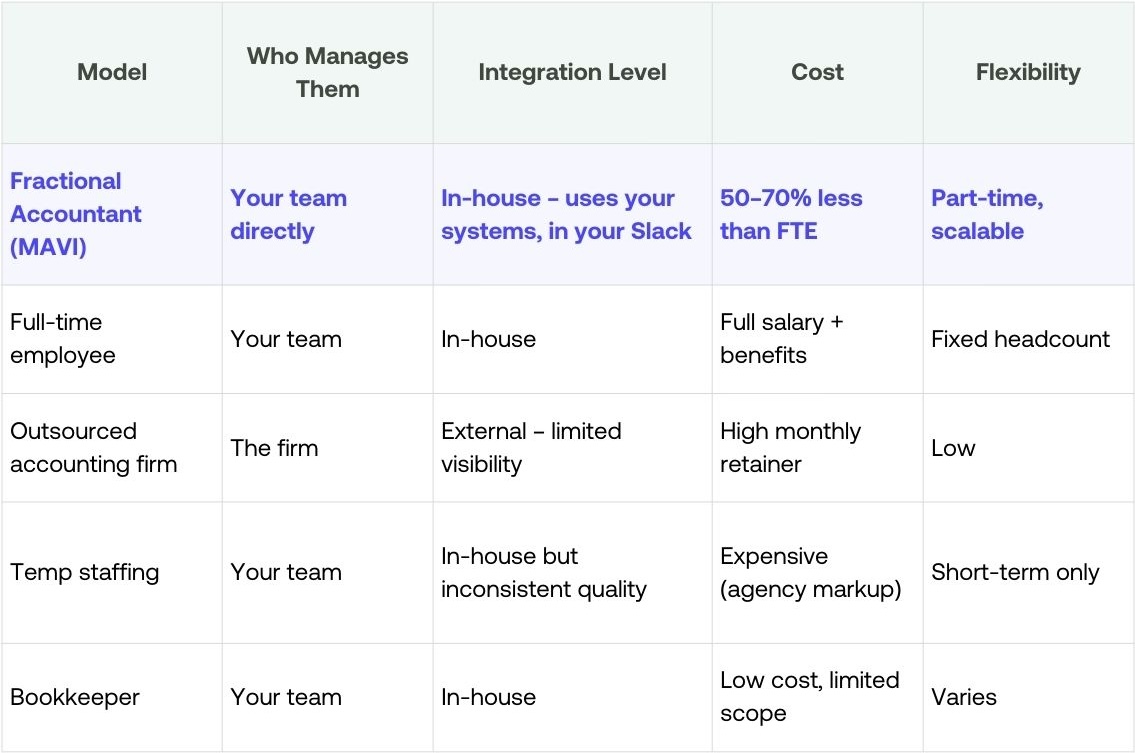
Fractional accountants are not the same as bookkeepers, outsourced accounting firms, or temporary staffers. They are skilled, mid-to-senior level accounting professionals who take genuine ownership of their scope: month-end close, accounts payable, accounts receivable, revenue reconciliation, audit preparation, and other substantive accounting functions – just at a capacity that matches what the business actually needs.
Fractional Accountant vs. Other Models: Key Differences
The key distinction between a fractional accountant and an outsourced accounting firm is integration and ownership. At an outsourced firm, an anonymous team works on your books without direct communication or visibility. A fractional accountant, like the part-time professionals in MAVI’s pre-vetted Talent Network, works inside your team – they attend your standups, communicate in your channels, and own their processes the same way a full-time hire would.
What Does a Fractional Accountant Do?
The scope depends entirely on what the business needs. Common responsibilities for fractional accountants placed through MAVI include:
Month-End Close Support
A fractional Senior Accountant manages the close cycle – journal entries, reconciliations, accruals, and close reporting – working directly within the company's ERP (NetSuite, QuickBooks, Sage Intacct). This is one of the most common use cases: a company needs dedicated close support but doesn't have enough volume to justify a full-time hire.
Accounts Payable (AP) Management
A fractional AP Specialist handles invoice processing, vendor payments, coding, and AP reporting on a part-time basis – typically 15–25 hours per week. As invoicing volume scales, hours can be increased without converting to full-time.
Accounts Receivable (AR) Management
A fractional AR Specialist manages customer invoicing, collections, cash application, and AR aging reporting. This is particularly valuable for companies with growing customer bases and increasing receivables complexity.
Revenue Reconciliation
For SaaS, fintech, and other companies with complex revenue models, a fractional Revenue Accountant manages revenue recognition, deferred revenue schedules, and reconciliation against billing systems.
Audit Preparation
A fractional Senior Accountant with Big 4 or audit experience can prepare the documentation, reconciliations, and internal controls work that external audits require – without the cost of a full-time audit-ready hire.
Process Improvement and Cleanup
Many companies bring in a fractional accountant specifically to clean up a chart of accounts, improve close processes, build SOPs, or address backlogs left by a departed team member. This is time-bounded work that doesn't require a permanent FTE.
When Should You Hire a Fractional Accountant?
There are five common scenarios where a fractional accountant is the right move:
Your Accounting Needs Don't Require Full-Time Capacity
If your current accounting workload genuinely requires 20–30 hours per week of skilled support, hiring a full-time employee adds 10–20 hours of unnecessary payroll cost. A fractional accountant lets you pay for what you actually need.
This is especially common at companies with 20–100 employees where the accounting function is growing but hasn't yet reached full-time complexity.
An Unexpected Departure Has Left a Gap
One of the most common urgent use cases: a key accountant leaves unexpectedly, and the remaining team cannot absorb the additional workload. A fractional accountant can step in quickly – MAVI places fractional talent in as few as 5 days – to cover the gap while a permanent search runs in parallel, or permanently if the fractional arrangement proves sufficient.
You Need Senior Accounting Expertise Without a Senior Salary
Experienced mid-level and senior accountants – professionals with 5–10 years of experience who can manage complex processes independently – are expensive full-time. A fractional Senior Accountant or AP/AR Specialist delivers that expertise at the hours and cost that fit the company's current stage.
Gerardo Adame, CFO at Verdant Robotics, described this use case directly:
"I urgently needed a strong in-house accountant who could understand the nuances of a robotics company. MAVI delivered exactly that – a part-time Senior AP Specialist who's been instrumental in managing AP and supporting month-end close, and has given me the leverage to focus on strategic finance as the CFO."
Your Accounting Function Is Scaling Faster Than You Can Hire
Fast-growing companies often face a lag between when accounting complexity increases and when headcount can keep up. A fractional accountant fills that gap – adding capacity immediately, with the flexibility to scale hours as the business grows.
Jackie Fleming, Head of Finance at MotherDuck, described this experience:
"We onboarded a part-time Senior Accountant and a Staff Accountant, handling everything from our month-end close activities to AP function to international payroll. I've been very happy with them – I'm even looking to increase their hours and responsibilities soon. They've made it so easy to scale our accounting function."
You Want to Test Fit Before Committing to Full-Time
The fractional engagement as a trial period is one of the most effective risk mitigation strategies in accounting hiring. Work with an accountant on a part-time basis for 30–60 days, evaluate their performance, and convert to full-time if the fit is strong. This eliminates the largest risk of a traditional full-time hire: paying a significant salary for someone who doesn't work out.
The Economics of Fractional vs. Full-Time
Consider a company that needs a Senior Accountant for approximately 25 hours per week.
Full-time hire (40 hrs/week):
Annual salary: $100,000
Benefits and payroll taxes: $25,000–$40,000
Recruiting fee (if using a recruiter): $20,000
Total first-year cost: ~$145,000–$160,000
Excess capacity: 15 hours/week paid but not fully utilized
Fractional hire through MAVI (25 hrs/week):
MAVI rate: 50–70% less than US equivalent
No benefits, no recruiting fee, no lock-in
Total annual cost: significantly less than full-time equivalent
Capacity matched to actual need
The savings are compounded when you consider that MAVI's fractional talent is pre-vetted – so you aren't spending 3 months hiring and 90 days onboarding before the person becomes productive.
What to Look for in a Fractional Accountant
Not all fractional accountants are equal. When evaluating candidates – whether through MAVI or any other channel – prioritize these qualities:
Autonomy
Can they own a process without constant check-ins? The value of a fractional hire evaporates if they require significant management overhead. MAVI's top-2% vetting specifically assesses for this.
Technical depth
Do they understand the accounting processes they're being asked to manage? For month-end close, do they know accruals and reconciliations? For AP, can they manage a complete invoice cycle independently?
Tool proficiency
Are they already proficient in your ERP and accounting tools? MAVI matches candidates on tool proficiency – NetSuite, QuickBooks, Bill.com, Ramp, and others – to minimize ramp time.
Communication
Remote fractional work is communication-dependent. Can they flag issues proactively, communicate clearly with stakeholders, and integrate into your team's cadence?
Reliability and staying power
Fractional placements can fail when the accountant treats the engagement as a lower-priority side commitment. MAVI's network is built of professionals who treat fractional work as their primary professional engagement.
How MAVI Places Fractional Accountants
MAVI is purpose-built for fractional and part-time accounting placements. Here’s how that process looks like:
Submit your requirements – role scope, tech stack, hours needed, start date
MAVI's algorithm surfaces matched candidates from its pre-vetted network (top 2% of applicants)
Review profiles and interview within 2–3 days
Onboard your fractional hire within 5 business days
MAVI handles payroll, compliance, and administrative overhead.
No upfront fees. No contract lock-ins. Month-to-month flexibility.
Hiring a Fractional Accountant with MAVI
A fractional accountant is the right hire when your accounting needs are real but don't fill a full-time schedule or when you need senior expertise at a cost and commitment level that full-time employment doesn't justify.
MAVI is the leading platform for fractional accounting placements: 5-day placement, top-2% vetting, 50–70% cost savings, and a track record of fractional hires who deliver like full-time team members. Book a call to hire a fractional accountant with MAVI today!
Frequently Asked Questions
What is a fractional accountant?
A fractional accountant is an experienced accounting professional who works part-time (typically 10–30 hours/week) as an integrated member of a company's team, owning real accounting responsibilities at a fraction of the cost and commitment of a full-time hire.
What is the difference between a fractional accountant and a bookkeeper?
A bookkeeper manages transactional record-keeping (data entry, categorization, bank reconciliation). A fractional accountant has deeper technical expertise – managing month-end close, financial reporting, complex reconciliations, and process improvement work that requires accounting judgment, not just data entry.
How much does a fractional accountant cost?
Costs vary by experience level, hours, and sourcing method. Through MAVI, fractional accounting talent is available at 50–70% less than US equivalent full-time rates, with no benefits burden, no placement fee, and no contract lock-in.
Can a fractional accountant replace a full-time hire?
For companies whose accounting workload genuinely requires less than full-time capacity, yes – a fractional accountant can deliver equivalent or better results at lower cost. Many companies that start with a fractional hire maintain that arrangement permanently because it matches their actual needs.
How quickly can I hire a fractional accountant through MAVI?
MAVI places fractional accountants in as few as 5 business days from initial inquiry to onboarding.