This guide covers the accounting tools that work best for remote teams, what each is best suited for, and how to ensure the accountants you hire are genuinely proficient in the stack you're running.
Written by
MAVI
Published On
March 24, 2026
The accounting tool stack a company runs determines what its accounting team can do – and how fast. A well-configured NetSuite environment with a skilled operator produces close cycles measured in days. The same environment with an accountant who's learning the system produces close cycles measured in weeks and close packages full of avoidable errors.
For fast-growing companies building remote accounting teams, two decisions matter equally: which tools to use, and whether your accounting talent actually knows them.
This guide covers the accounting tools that work best for remote teams, what each is best suited for, and how to ensure the accountants you hire are genuinely proficient in the stack you're running.
Core ERP / Accounting Software
NetSuite
The most commonly used ERP among scaling companies – VC-backed, PE-backed, and mid-market alike – NetSuite handles the full accounting function: general ledger, accounts payable, accounts receivable, revenue recognition, fixed assets, multi-entity consolidation, and financial reporting.
Best for: Companies with $5M+ in revenue that have outgrown QuickBooks and need multi-entity support, robust reporting, or industry-specific modules.
What to assess in hiring: NetSuite proficiency ranges from basic journal entry and reconciliation to advanced multi-entity configuration, custom saved searches, and revenue recognition modules. For remote close support, assess whether the candidate has run a full close cycle in NetSuite – including how they handle inter-company transactions, accruals workflow, and period-end lock.
QuickBooks Online (QBO)
QBO is the dominant accounting platform for companies under $5M in revenue and for smaller clients of accounting firms and fractional CFOs. QBO handles the core accounting function, including GL, AP, AR, bank reconciliation, and payroll integration, with a simpler interface than NetSuite.
Best for: Early-stage companies, SMBs, and fractional CFO client portfolios.
What to assess in hiring: QBO competency is more widespread than NetSuite, so the bar for claiming proficiency is lower. Assess whether the candidate can handle bank feed reconciliation, manage multi-class reporting, run AR aging and collections, and produce accurate P&L and balance sheet for period-end review.
Sage Intacct
Increasingly popular among nonprofits, healthcare, and services companies that need strong multi-entity and fund accounting capabilities, Sage Intacct is a cloud-based modular financial management and accounting software.
Best for: Multi-entity organizations, nonprofits, and industries with fund accounting requirements.
QuickBooks Desktop / Sage 100
QB and Sage 100 are both legacy platforms still common at mid-market companies that haven't yet migrated to cloud ERPs. These are important for PE-backed middle market companies that may be running on legacy systems pre-transformation.
AP Automation
Bill.com
Bill.com is the leading accounts payable automation platform for SMBs and growth-stage companies. It manages invoice receipt, approval routing, payment processing, and vendor management, and syncs to other ERPs like QBO and NetSuite.
What to assess in hiring: Can the candidate configure approval workflows, manage vendor onboarding, handle payment runs (ACH, check, international wire), and reconcile Bill.com to the GL? Operators who know Bill.com well reduce AP processing time significantly.
Ramp
Ramp is a corporate card and spend management platform with built-in AP capabilities. Increasingly used by tech companies as a unified spend management layer, replacing or complementing Bill.com for certain vendor payment flows.
What to assess in hiring: Ramp proficiency is newer and less universal, but candidates with Ramp experience can typically configure card controls, manage expense reporting, and integrate Ramp data into the accounting close.
Tipalti
Used by larger companies with high-volume international payment needs – media, SaaS, marketplace businesses – Tipalti handles supplier payments, tax compliance, and payment reconciliation at scale.
Expense Management
Expensify
Expensify is a leader in employee expense reporting and reimbursement, seamlessly integrating with NetSuite, QBO, and other ERPs. It’s widely used at companies with travel-heavy teams.
Ramp / Brex (expense module)
Ramp, along with Brex’s expense module, are corporate card platforms that combine spend control with expense reporting. These are increasingly replacing Expensify for companies that want a unified card and expense solution in one.
Payroll
Many remote accounting teams handle payroll reconciliation rather than payroll processing itself – ensuring payroll entries are coded correctly in the ERP and reconciled to the bank. That said, here are some of the best supplemental accounting tools used by most remote teams:
Gusto: Best for companies under 100 employees. Strong QBO integration.
Rippling: Full HR + payroll + IT platform. Increasingly common at tech companies.
ADP / Paychex: Traditional payroll providers. More common at mid-market companies.
Billing and Revenue
Stripe
Stripe is dominant at SaaS and e-commerce companies for payment processing. Revenue recognition for Stripe-based revenue is one of the more technically demanding accounting tasks at growth-stage companies.
Chargebee / Recurly
Chargebee and Recurly are subscription billing platforms common at SaaS companies. These tools require accountants who understand deferred revenue, MRR/ARR reconciliation, and ASC 606.
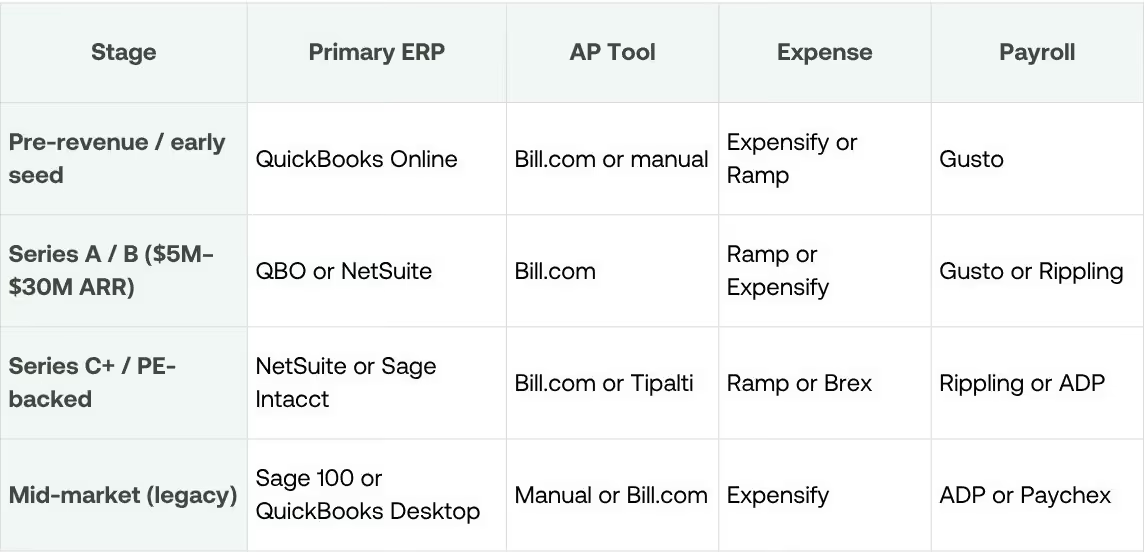
Tool Stack by Company Stage: A Reference Guide
Why Tool Proficiency Is a Hiring Requirement
The ramp time for an accountant learning a new ERP from scratch is 60–120 days at minimum. For a remote accountant joining a lean team, those 60–120 days produce a fraction of the value they'll eventually deliver – and require disproportionate management time to support.
Contrast that with a tool-matched hire: an accountant who knows your exact ERP, AP platform, and billing system can contribute meaningfully in week one and own their processes independently by week three.
The math is straightforward. For a 12-month engagement, a tool-matched hire delivers approximately 10–11 months of full productivity. An unmatched hire delivers 8–9 months at best. The productivity difference is equivalent to having one to two additional months of high-quality accounting work per year.
This is why MAVI's matching process includes tool proficiency as a core dimension – not a secondary consideration. Every candidate presented to a client has been assessed on the specific tools in that client's stack.
How to Assess Tool Proficiency in a Hiring Process
Generic accounting interviews routinely fail to detect tool proficiency gaps. Candidates who list "NetSuite" or "Bill.com" on their resume are frequently far less proficient than the listing implies.
Use these evaluation approaches to surface real proficiency:
ERP-specific scenario questions:
"Walk me through how you'd close a period in NetSuite. What's the sequence of steps, and what would you do if you found a reconciling item on day 7?"
"How do you handle deferred revenue in NetSuite's revenue recognition module? Walk me through a specific example."
"In QBO, how do you handle a bank feed with duplicate transactions from a Stripe payout?"
Tool-specific process questions:
"Describe how you'd set up a new vendor and an approval workflow in Bill.com."
"How do you reconcile Ramp data at month-end? What's your process for coding uncategorized transactions?"
Specific past experience probing:
"On a scale of 1–10, how proficient are you in NetSuite? What's the most complex thing you've configured or managed in it?"
"What's the largest AP volume you've processed monthly in Bill.com? How did you manage vendor payment runs?"
Candidates with genuine proficiency answer these questions with specificity and fluency. Candidates who are overstating their experience give vague, hesitant answers or claim they "learned as they went."
MAVI's Tool Stack Matching Process
Every MAVI candidate is assessed on their specific tool proficiencies during the vetting process. When a company submits a requirement – including the exact tools in their stack – MAVI's algorithm filters and ranks candidates on tool match as a primary criterion.
This means the candidates MAVI presents have been assessed on your specific ERP, AP platform, and billing system, not just screened for general accounting experience.
MAVI commonly places accounting talent proficient in: NetSuite, QuickBooks Online, Sage Intacct, Bill.com, Ramp, Expensify, Stripe, Chargebee, Gusto, Rippling, and others. If your stack includes tools not on this list, MAVI can capture that requirement and match you with the best talent accordingly. Book a call to learn more!
Frequently Asked Questions
What accounting tools should remote accounting teams use?
The standard modern stack for growth-stage companies: NetSuite or QuickBooks Online (ERP), Bill.com or Ramp (AP), Expensify or Ramp (expense), and Stripe or Chargebee (billing). The right choice depends on company size, industry, and complexity.
How do I know if an accounting candidate really knows NetSuite or QuickBooks?
Ask ERP-specific scenario questions tied to actual close processes – not generic accounting questions. Genuine proficiency shows up in specific, fluent answers. Surface-level familiarity produces vague responses.
Does MAVI match accounting candidates to specific tools?
Yes. MAVI's matching process includes tool proficiency as a core assessment dimension. Candidates are evaluated on your specific tool stack before being presented – eliminating the mismatch risk.
How long does it take an accountant to become productive in a new ERP?
Typically 60–120 days to full productivity in an unfamiliar ERP. Tool-matched hires through MAVI contribute meaningfully in week one and own their processes independently by week three.